

 9.3 / 10 - 4518
reviews
Why is SOLIDHODL the best backup for your recovery words (recovery seed)?
At the end of 2022 we were preparing a video. "Top 10 recovery seed backups" was going to be the title. During the preparation, a question came up: which seed backup do we think is the best? And our answer was: "...". We didn't know! And not because we weren't familiar with these products, but because none of them fully convinced us. Every product had its pros and cons, and we saw no clear winner.
Of course, we're not impartial: SOLIDHODL is our own product. That's why we explain below exactly which choices we made and why, so you can judge for yourself whether you agree with us.
Drawbacks of other seed backup products
The drawbacks we noticed:
- Wrong choice of material
- Lots of loose parts: impractical to use and easier to lose
- Dependence on a translation booklet
- Error-prone way of recording
- Expensive products
- No way to add an identification number to the product (handy if you have more than one)
How SOLIDHODL came about
You guessed it: this is where the idea for SOLIDHODL was born. SOLIDHODL is the result of analysing and using other seed backup products, researching what others have written about them, and running our own practical tests. Below, we go through the six drawbacks one by one.
Choice of material
Stainless steel (AISI 304 and 316) and titanium are the most common and also the most logical material choices for a seed backup. And although titanium is often marketed as a "premium metal", we prefer stainless steel AISI 316.
Yes, titanium has advantages:
- A higher yield strength: the widely used titanium grade 2 deforms permanently less quickly at room temperature than stainless steel 316 (at least 276 versus 205 MPa, about 1.3 to 1.4 times as high). In tensile strength, stainless steel 316 actually scores higher (515 versus 345 MPa).
- It is more resistant to rust and acids (AISI 316 also resists rust well, AISI 304 less so)
- It is more heat-resistant: titanium only melts at around 1,668°C, stainless steel 316 between 1,375 and 1,400°C
But when you combine "strength" and "heat", titanium suddenly is no longer the winner. An average house fire reaches about 600°C, which is why stress tests of metal seed backups go up to around 1,100°C to simulate a severe fire. According to the manufacturer, titanium grade 2 is intended for continuous use up to about 425°C. At around 880°C its crystal structure also changes, and hot titanium absorbs oxygen from the air, creating a hard, brittle outer layer. So it doesn't melt yet, but it does become a lot more vulnerable.
Stainless steel retains its strength better at those temperatures. This was already shown in a test by the US civil aviation authority (1957), which compared titanium and stainless steel as firewall materials: between 540 and 980°C, stainless steel remained stronger than titanium throughout. Under a flame of over 1,090°C with a load applied, the titanium panels deformed more than the stainless steel panels, and two of them even cracked. So if you have a fire with a risk of collapse, stainless steel has a much better chance of coming through it intact than titanium.
On top of that, stainless steel AISI 316 also performs well on the other factors, such as strength and heat resistance (titanium is only slightly better). That's why SOLIDHODL is made of stainless steel AISI 316.
One single part
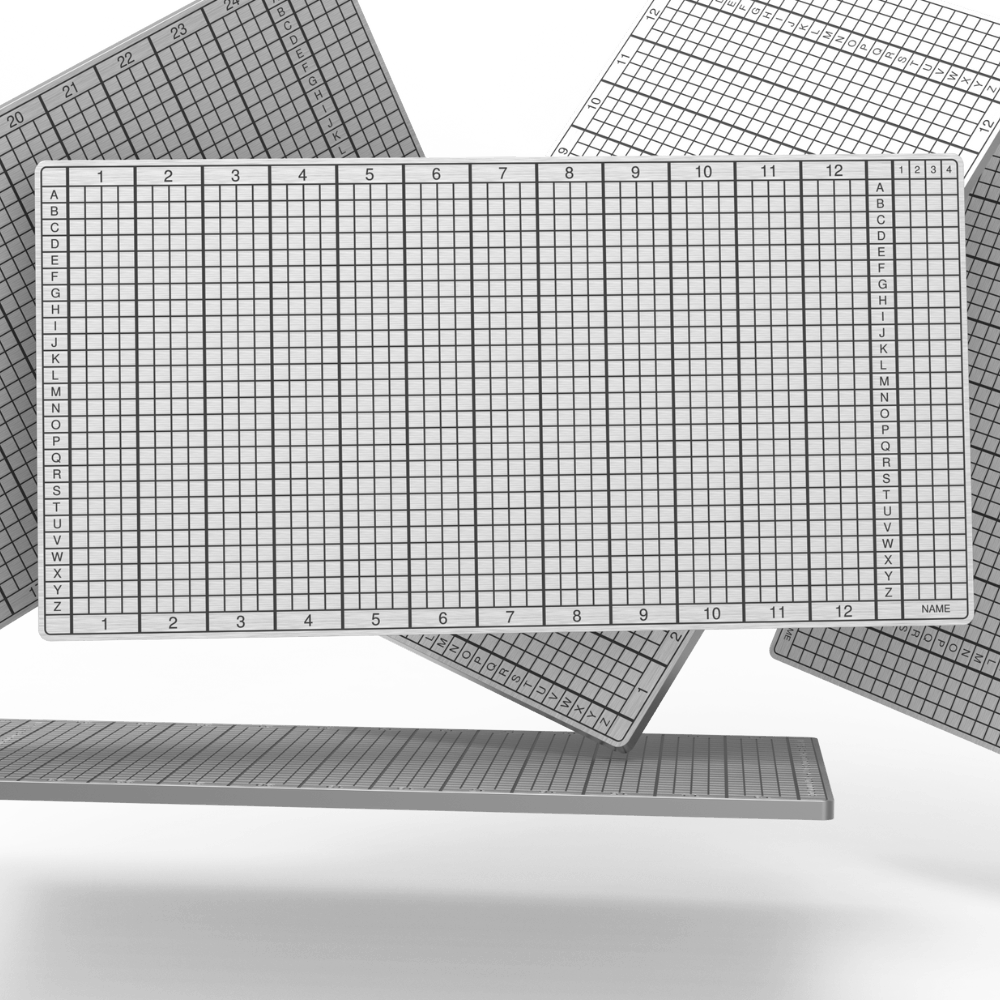
Some backup products consist of lots of parts, such as loose letter tiles, screws and small frames. That makes recording your seed cumbersome. And even if the parts are attached to each other, in theory they can come loose or get lost more easily than with a product made from a single piece. Well-known tester Jameson Lopp also says he has less confidence in backups with tiles that can come loose. That's why SOLIDHODL consists of a single plate where nothing can come loose: you punch your words directly into the steel with the punch tool.
Independent
With some other seed backup products, you record numbers instead of the letters of your recovery seed words. This creates an extra dependency when translating your seed: you need a booklet or table that explains which number represents which word.
That's why SOLIDHODL works with letters. You record the first four letters of each word (or the whole word, if it's shorter). That's all you need: the standard word list that almost all wallets use (BIP39, 2,048 words) is designed so that the first four letters of every word are unique. The same applies to Trezor's 20-word backup (SLIP39, 1,024 words), the default on devices such as the Trezor Safe 7. With those four letters, you always know exactly which word it is, without a booklet or table.
Error-free
If there's one thing you don't want, it's recording your recovery seed incorrectly. That could cost you all your crypto. In our experience, with many products you find yourself doubting whether you're doing it right and whether you've made a mistake somewhere. The result is that you double-check everything, and then check it again. There's nothing wrong with checking once, but if you do it because you genuinely doubt whether it's correct, that's not a good sign. That's why SOLIDHODL comes with a sleeve that helps you focus on one word and one column at a time. That way you won't get distracted by the rest, and the doubt disappears.
Price
Many seed backup products cost 100 euros or more. We noticed that for many crypto users it feels strange to pay more for their backup than for their hardware wallet. So we looked at how we could make the product both high-quality and affordable. SOLIDHODL costs just €89. And you can also order extra SOLIDHODL plates for just €69 each.
Identification number
Other single-plate solutions in particular offered no way to give a plate a number or name, even though that's very handy if you have more than one backup. That's why with SOLIDHODL you can give each plate a name of up to 8 characters.
Curious how recording your seed works in practice? In this video we show you step by step how to record your recovery seed with SOLIDHODL. You can also find a written guide on our SOLIDHODL start page.


Conclusion
There's no such thing as a perfect seed backup, and as we said, we're not impartial. But with SOLIDHODL we've tried to solve every drawback we came across in other products: stainless steel 316 that retains its strength better in a fire, a single plate without loose parts, letters instead of codes, a sleeve that prevents mistakes, a fair price and room for your own name. Want to compare for yourself? Our overview of all seed backups lists the alternatives.
Frequently asked questions
Does a recovery seed of 12, 18, 20 or 24 words fit on SOLIDHODL?
Yes. The front and back each have room for 12 words, so 24 in total. A seed of 12, 18 or 20 words therefore fits as well. The latter is, for example, the 20-word backup (SLIP39) that Trezor uses by default on the Safe 7, Safe 5 and Safe 3.
How does the sleeve work?
The sleeve covers the rest of the plate, so only the column of the word you're working on is visible. That way you won't get distracted by all the lines and won't accidentally punch in the wrong column.
Can I order extra plates?
Yes, the separate SOLIDHODL Plate is handy if you have multiple wallets or want to store your backups in different locations. You can simply reuse the sleeve and punch tool from the Pack.
Where is the best place to store my SOLIDHODL?
In a safe place, for example in a safe. If you want to be able to see whether anyone has tampered with it, put the plate in a sealbag. You can find more tips in How do you protect your recovery seed phrase?
Sources
- Rolled Alloys / Ulbrich: titanium grade 2 datasheets
- Carpenter Technology: CP titanium grade 2 datasheet (alpha case)
- Alloys International: stainless steel 316 datasheet
- Civil Aeronautics Administration (1957): A Brief Study of the Suitability of Titanium and a Titanium Alloy as Firewall Material
- Jameson Lopp: Metal Bitcoin Seed Storage Stress Tests
- BIP39 word lists (bitcoin/bips on GitHub)
- SLIP39 word list (SatoshiLabs on GitHub) and Trezor: Single-share Backup
 WhatsApp
 Email